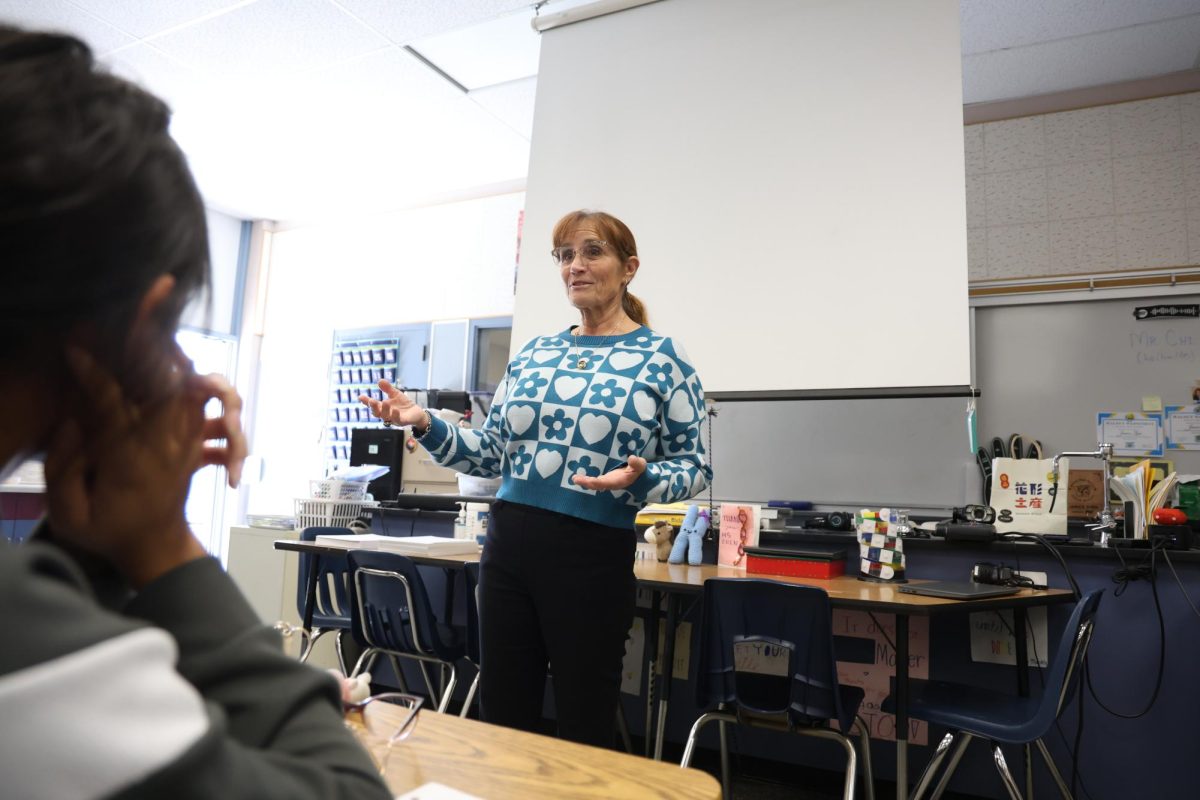
![American Sign Language (ASL) teacher Sara Gray-Castro signs her Deaf name given to her by a fellow Deaf teacher she met in 2017 at a ASL Teachers Associations conference. Deaf names are unique to the Deaf community and often describe the appearance of the person, which can not be given by the person themselves, but by another member of the Deaf community.
“He came up with [my] name sign based on my natural red hair, blue eyes and freckles. And the four finger movement is indicated for my four letter name, Sara,” Gray-Castro said.](https://whshoofprint.com/wp-content/uploads/2026/01/Screenshot-2026-01-30-101455.jpg)
Teaching was something that never came across American Sign Language (ASL) teacher Sara Gray-Castro’s mind 11 years ago. Encouraged by a friend, an ASL professor, she entered the halls of Northview High School into the class where her friend taught, observing from the back. When she was brought to the front, encouraged to try to teach, she froze. However, when she turned her head to look back at the PowerPoint projected on the screen, her knowledge of ASL came naturally and her worries disappeared as she got into the rhythm of conveying what she knew best. Ever since then, the pleasant surprise has led to her passion for teaching ASL.
Gray-Castro, part of the Mt. SAC Dual Enrollment program, teaches ASL, the primary language of the Deaf community in the United States, through the courses Sign 101 and Sign 102 at Walnut High School (WHS). ASL is characterized by hand gestures, movements, facial expressions and body language. As a member of the Deaf community, she aims to not only teach her students ASL, but also have them leave the class educated on Deaf culture and communication.
“ASL is my language, and it’s important for me to inform people about my culture, so that they have an idea of what the Deaf community is like,” Gray-Castro said. “My goal is for others to have communication with Deaf people, whether they learned it for work or just to enjoy the language.”
Gray-Castro embraces ASL as an integral part of her identity as a Deaf person, setting aside hearing aids after she graduated high school. Teaching ASL since 2016, she holds an A.S. in Language Arts and Communication, a B.A. in Anthropology, completed M.A. coursework in Socio-Cultural Anthropology and completed her second M.A. in Sign Language Education from Gallaudet University. She notes differences between the Deaf and hearing communities, but is strongly against misconceptions of the Deaf community.
“What I want people to know is that Deaf people can communicate, and so I want people not to be afraid to learn and try to communicate with Deaf people. It’s important for people to know because Deaf people like to make connections,” Gray-Castro said. “Most people assume that Deaf people [always] ‘can’t.’ They can’t drive, they can’t work, can’t work out — it’s just that word, but it’s just not true. My goal is to teach that the Deaf can.”
In class, Gray-Castro prioritizes interactive and visual activities in class to help students retain vocabulary and sentence structure through repeated practice. Throughout her teaching journey, she even mentored and provided support to aspiring ASL interpreters. Regardless, she provides opportunities and events for all her students to get involved in the Deaf community, which often encompasses a wide variety of activities such as history lessons about Deaf culture and merchandise, including Deaf art.
“I tend to research [Deaf events] and announce them to my students [and] encourage them to go,” Gray-Castro said. “I [especially] wanted [the aspiring interpreters] to be engaged. I encouraged them to practice as much as they could by going to tutoring, Deaf events and to be more involved in the Deaf community to build confidence in their skill.”
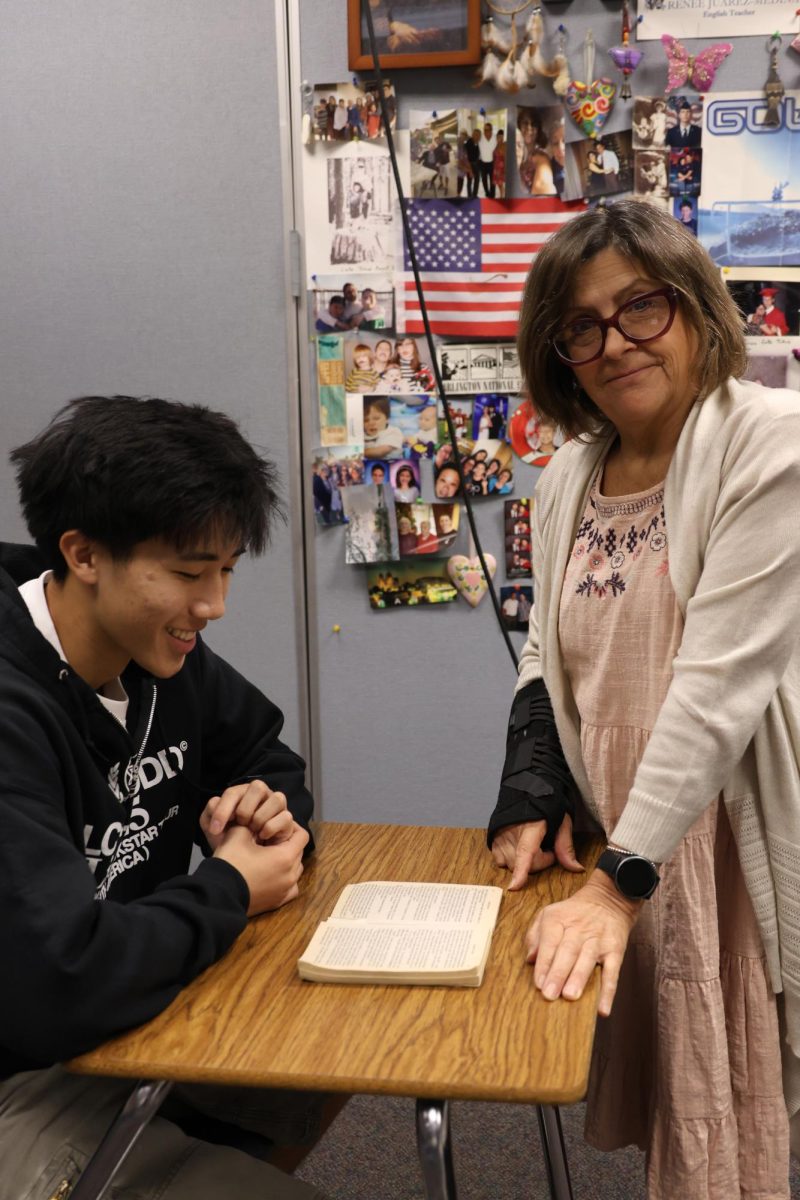
Gray-Castro’s class is especially fun for Gray-Castro’s student, senior Serena Chiu. Her ASL journey began from a young age, but she soon lost touch with the language and decided to pick it up again at WHS in order to communicate better with her Deaf friends.
“She’s fun and energetic and has really creative ways to get us to learn and practice our signs. She is very understanding and patient with all of us. And I like the games that she does,” Chiu said. “I was surprised at how many people thought that just because you’re deaf you’re incapable of doing things, or how some interpreters would interpret things incorrectly just because they think it would be more convenient for Deaf people—but in reality, it [isn’t].”
When Gray-Castro was born, her deaf condition was not known until she was 2 years old. When she was playing with her dad’s shoes, her mother struggled to get her attention, resorting to using a pot and a spoon in an attempt to draw her awareness. Continuing to show no response, her mother immediately sensed something was off. Prior to this incident, Gray-Castro had been infected with a serious fever when she was 6 months old, which is what her mother believes to be the cause of her deafness. Gray-Castro feels that fact is false, and moving forward, her parents practiced oralism — a form of education for deaf people, encouraging speech practice.
“I believe that my beliefs and my parents’ beliefs [regarding the Deaf] are different; I see something one way, and they see another,” Gray-Castro said. “They didn’t force me to speak, but their goal was to have me learn speech. They didn’t realize how that influenced and impacted me.”
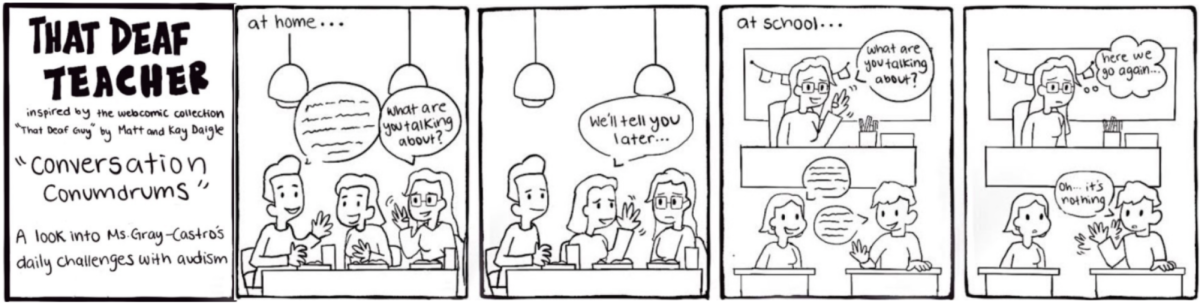
Gray-Castro’s biggest challenge growing up was audism — discrimination and prejudice against Deaf people —whether it was being excluded from conversations at dinner tables, dealing with restaurant employees who refused to read her orders, following through on her request for an interpreter, or getting bullied in school for having to repeatedly ask the teacher what was taught. She has noticed better accessibility and understanding toward the Deaf, making communication easier and helping her build more connections.
“[These situations] become habitual. You get used to it, having that oppression happen over and over again and not being included,” Gray-Castro said. “I improved on it over time. [However], sometimes now I can go up to someone, and they know ASL, which I think is amazing and makes me feel so good that I don’t have to be using any other form of communication, just my own language. That is why I teach ASL, so when my students go out in the workforce, they will have that communication with the Deaf.”
Featured around Gray-Castro’s room in P-5 are various projects relating to Deaf culture and audism, a number of drawings or student gifts of her favorite sign: “sea turtle.” She has a love for the ocean and sea creatures, as a former swimmer on her high school’s swim team. Her favorite way to pass time is to binge-watch shows on various streaming platforms and her favorite franchise is “Star Wars,” with a particular fondness for the character Yoda for his communication style.
“[Yoda is my favorite character] because of the way he speaks. His sentences are usually flipped around, and that structure and grammar is similar to that of ASL,” Gray-Castro said. “For example, in English, you would say, ‘I like ice cream.’ For ASL, you would initiate the subject or the topic of the sentence before talking about the action or the verb, so it would be ‘Ice cream I like.’”
At WHS, Gray-Castro also advises the ASL club, where she enjoys seeing members take charge in their learning and understanding of ASL. The club actively practices signing and is currently fundraising for the club to attend Deaf events, including the Los Angeles Angels Game on May 18, where they will be given the opportunity to sign the national anthem.
“My favorite part of the ASL club is seeing them all sign together as a group, learning and practicing so enthusiastically. I love the involvement and the participation because I [get to] step back and I let them lead it themselves,” Gray-Castro said. “It’s good for the students to continue practicing and learning more about Deaf culture and [build] connections with the Deaf community.”
ASL club president junior Mylene Oviedo was inspired to further her passion after a positive experience in Gray-Castro’s class and attending the Angel Stadium event last year. Each meeting, she organizes activities and a comfortable environment for members to have fun practicing their signs.
“I was with Gray-Castro a lot more [because of my involvement], and it was fun learning from her. She is really nice and makes learning fun with her, always making jokes,” Oviedo said. “We’re always just trying to spread more awareness [about] the Deaf community.”
Along with getting more involved, Gray-Castro’s teaching has allowed her students to gain more awareness of the world. Gray-Castro’s teacher assistant, senior Roman Macali, has built more empathy over the years from being her student.
“I think we are in an age of being progressive and accepting, and we’ve made progress on that, but people don’t realize that people within the disabled communities [experience discrimination as well]. But then again, a lot of things about these communities go forgotten underneath,” Macali said. “It’s really disheartening. Deaf people in particular [are expected to] learn how to talk in a language that they can’t hear or understand, speak noises they can’t hear. And when they can’t do that, they are expected to be ‘fixed’ with cochlear implants or other stuff. It’s like you’re expected to do that in order to integrate into society.”
More than anything, Gray-Castro wants to raise awareness and continue to use her story and experiences to advocate for the Deaf community, shaping the way she teaches and lives.
“Every day, I try to emphasize the values of Deaf culture —communication and respect are big ones. I want to emphasize that we’re all the same, and that the only difference [between the Deaf and hearing] is that Deaf people can’t hear. I want my students to understand that we’re the same, and the only difference is communication.” Ω