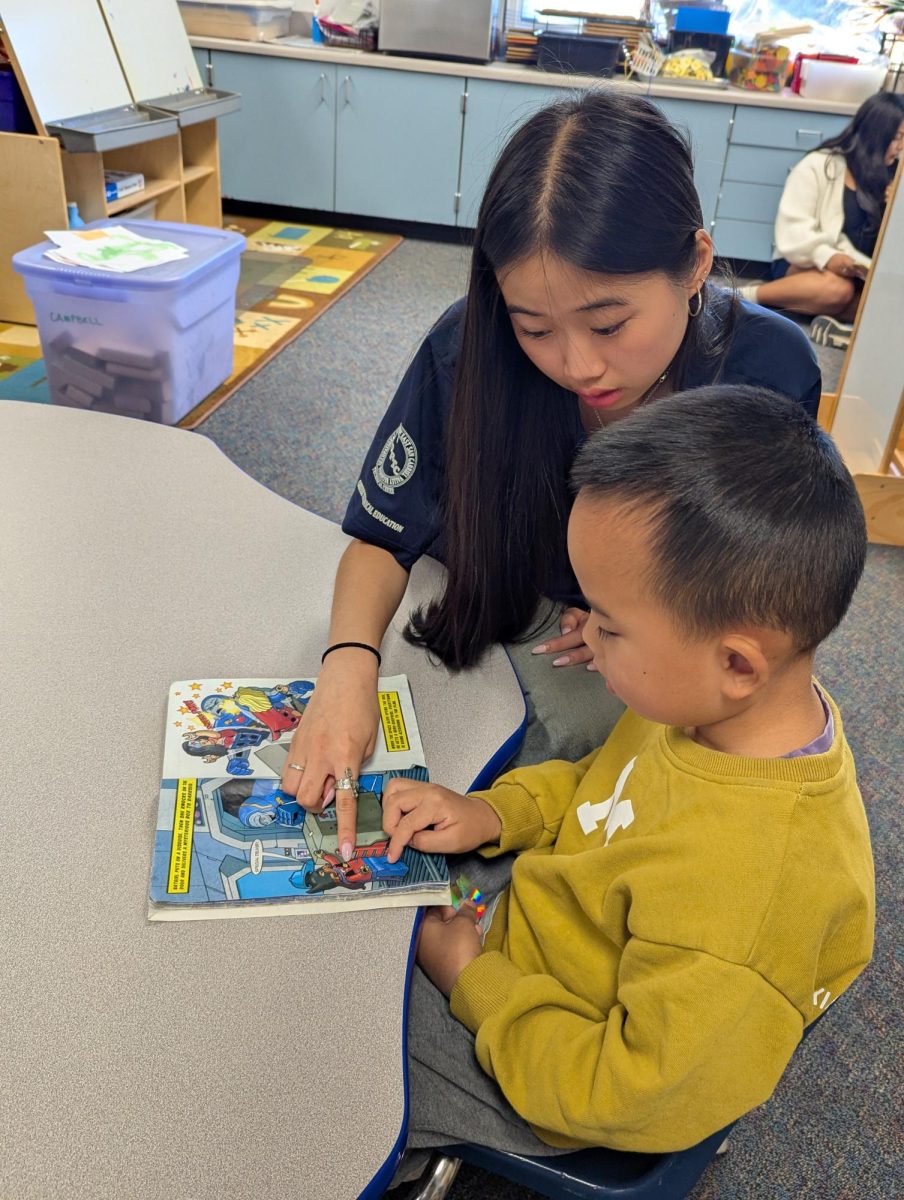
To begin their work-based learning, students from the Career and Technical Education (CTE) Advanced Childhood Education class visited Vejar Elementary on Wednesday, Oct. 8 and Collegewood Elementary on Thursday, Oct. 9.
Gaining real-life experience, students help lead activities in Transitional Kindergarten classrooms at Vejar and Collegewood every Tuesday and Thursday, respectively. The highschoolers were separated into three groups, with each group receiving either a whole elementary class or a group of students to work with for the day.
“The advanced class is more practical, so they take all the knowledge that they have learned and actually use it in the field,” Childhood Education teacher Maggie Wong said. “At Collegewood, the teachers specifically wanted a more mathematical focus, so my students helped the [elementary school students] endure a more cognitive load and how to count for a long time without giving up.”
In particular, the Advanced Childhood Education class focused on how to help the kids open up about themselves.
“We really focused on empathy and understanding how everyone works,” senior Cara Cheung said. “We wanted to be patient, especially with the kids, and in these ways, we can find the right way to get to know them and let them open up.”
The high schoolers also created interactive activities for the students to participate in. For example, the Advanced Childhood Education class created a lesson where the kids did “Counting Collections.” In this activity, they had to count and tally up 20 different objects individually, which the elementary students often found difficult.
“It was hard to make them understand some things because their brains don’t work certain ways, so we tried to make the assignments easier,” senior Aamir Zayid-Ranien said. “But it was very memorable just seeing the kids smiling and having fun in [the activities].”
From this opportunity, the high schoolers also learned important soft skills such as socializing with young children and being good listeners. As such, these skills can be applied to help the students in the future to be more successful, especially when it comes to the childhood education field.
“It gives us the experience that we need since with young kids, you need to know how they specifically work,” Cheung said. “It also helps with being more outgoing. In class, we are all kind of introverted, but when we are at the elementary schools, we can be a lot more active.”