Students traveling during spring break were affected by increased gas prices. As the Strait of Hormuz — located between Oman and Iran where about 20 million barrels of gasoline a day flow through — continues to close and reopen on a daily basis due to political tensions with the Iran-Israel war, fuel prices continue to increase.
With spring break being one of the most traveled times for students, rising fuel prices impacted how many were able to travel. Other than traveling themselves, many students had relatives visiting from other countries, sharing their experiences.
“It’s actually really bad all around the world. It’s gotten so bad that some of my relatives in the Philippines, who do drive are not getting oil because of all the closures,” junior Angela Mei Unayan said.
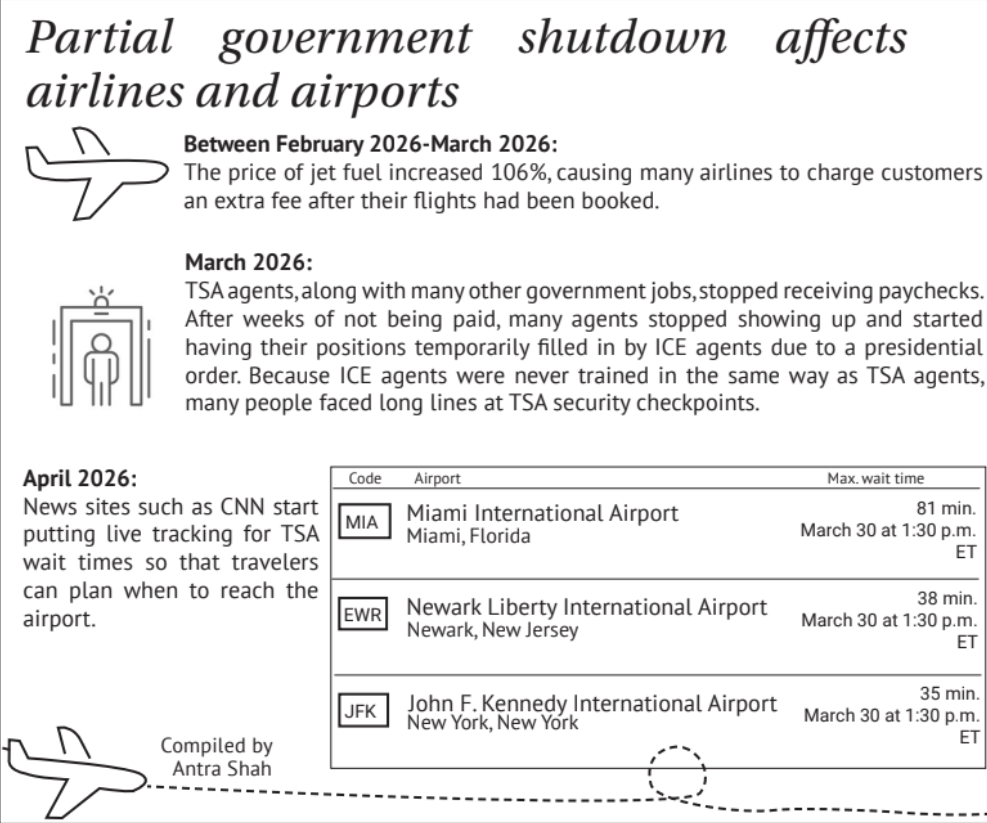
With the Strait of Hormuz effectively closed since March 4, the shipping costs of oil have risen to make up for the increased time and fuel to ship out the oil. With the limited number of barrels passing through the strait, countries are looking to countries such as Russia and Venezuela to buy oil, triggering a supply-chain imbalance. Airlines have increased their airfare to offset the cost of fuel, with ABC News reporting that United Airlines has warned travelers that airfare could climb as much as 20% in the summer, and CBS News reporting that airlines have already increased the price of domestic flights, costing $55 more per trip.

In addition to the extra fees tacked on by airlines to help cover the fuel costs, airport Transportation Security Administration (TSA) lines had a substantial increase in wait times due to a lack of trained TSA officers working. This is the result of a partial government shutdown affecting the Department of Homeland Security (DHS).
According to NPR News, with over 480 officers quitting and daily call-out rates reaching up to 50% at some airports, wait times reached over four hours — the longest in TSA history. Lines started to decrease as TSA workers returned with pay, through a specific fund created for TSA workers, supplying $10 billion, but as of April 19, 2026, the fund has now been reduced to $1.4 billion, according to CNN. While the bill is not a permanent solution, the situation gave lawmakers more time to figure out a permanent solution.