Peer pressure is one of the factors that contribute to abusing drugs such as nicotine.
The Merriam-Webster dictionary states that peer pressure is “a feeling that one must do the same things as other people of one’s age in order to be liked or respected by them.” Social norms also play a role in how people could feel peer pressured to use drugs. School psychologist Robert Coad believes that there are two contrasting aspects of peer pressure.
“Sometimes peer pressure can be positive. [However], negative peer pressure [pulls you off] of who you are [as a person]. That’s something we want to have our students be able to identify, when they’re being pulled in a direction that’s not positive,” Coad said.
According to an article by the National Library of Medicine, “adolescents with fewer (less than four) Alcohol and Other Drug friends were more likely to be abstinent [to be sober] than those with four or more AOD-using friends.”
“Everybody in high school is trying to figure out who they are and what they want to be like. There’s pressure from all of these different groups, whether it be ‘maybe come to a party and try things that you wouldn’t normally do’ or ‘try a new activity.’ I think that pressure is constant,” Coad said.
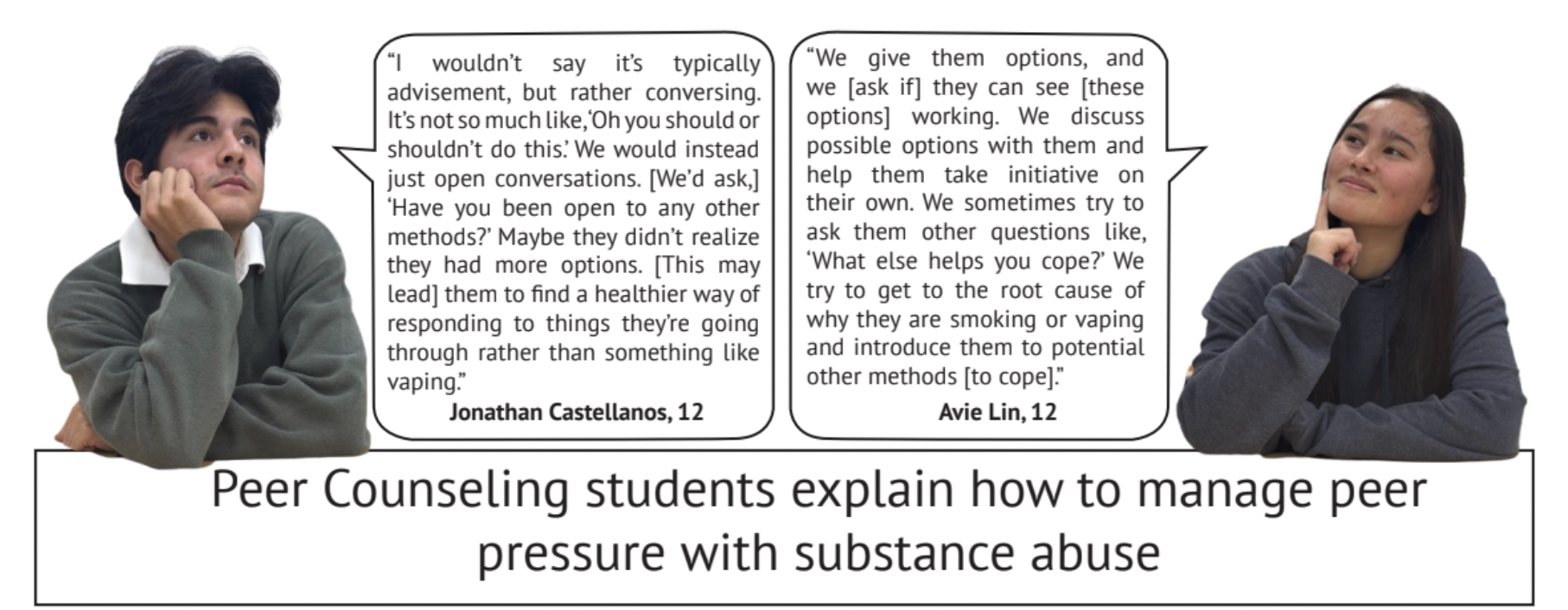
Peer pressure holds a significant factor in not only substance abuse but also in social settings. Students may feel pressured by their peers and turn to substances in order to be liked or perceived in a certain way. Grade Level Coordinator Jennifer Tucker acknowledges how difficult it is to say no and suggests students make up excuses or directly say no. Other advice that would be typically given to students would be to stand their ground and to set boundaries. A major factor that plays a role when advice is being given is mental health.
“For me, I look at who the student is and what I feel that they’re capable of. [Questions I would ask myself] are do they need some help trying to get out of the situation?” Tucker said.
According to the 2021 National Survey on Drug Use and Health, it is estimated that 21 percent of teens who have used an illegitimate substance at least once did so because of peer pressure. School therapist Jena Muhr advises students to always tell someone if they feel hesitant or scared to reach out about peer pressure.
“Make your own decisions and do what you know to be right. And if you are feeling like “just this one time” or something [similar] it is probably not the right decision to make,” Muhr said.