Stepping into a Waymo feels like stepping into the future. There’s no driver in the car, so the car greets passengers with tablet-like screens, reassuring riders that although no human is driving, the customers are in good hands. Located in Phoenix, San Francisco, Los Angeles (LA), Austin and Atlanta, Waymo is quickly expanding and becoming the car of the future.
The interface of the screen is simple but limited, with more features becoming available once connected to the Waymo app. While the system may feel basic to tech-savvy users, its simplicity makes it easy for first-time riders to navigate without confusion.
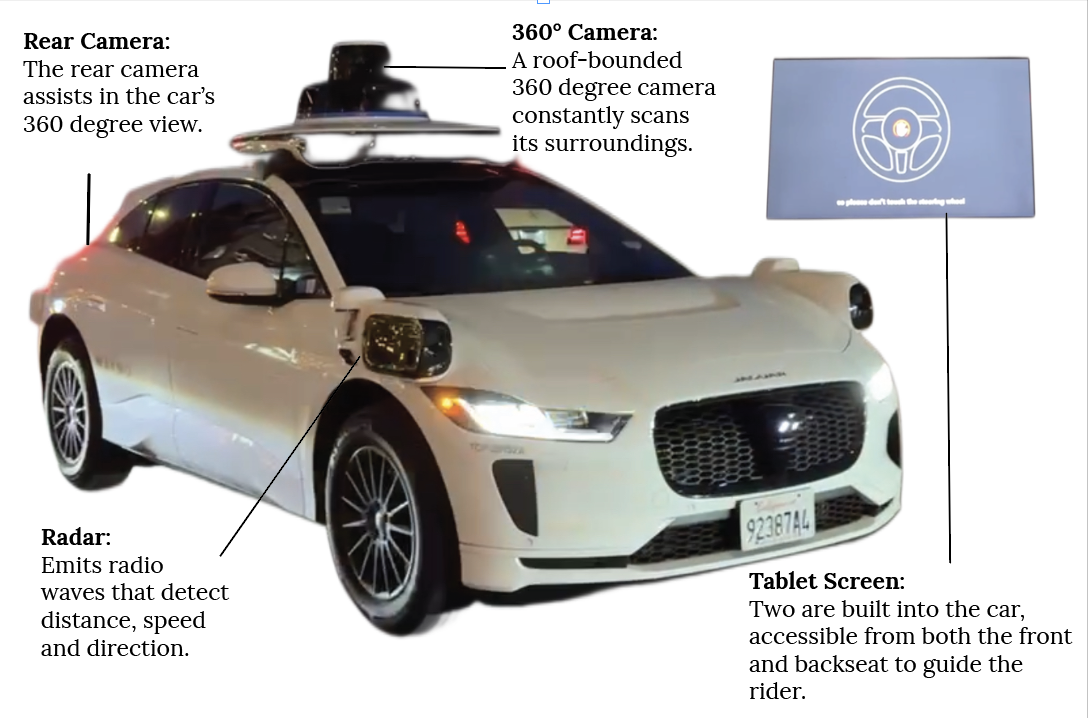
First, riders must order the ride on the app. Once inside, the main screens-one in the front and one in the backseat-allows riders to start the trip, view the route, check the estimated time of arrival and choose their preferred music. The screens also display a live map of the trip, showing nearby cars, pedestrians and traffic signals, which helps riders understand what the vehicle is reacting to in real time.
I rode a Waymo in LA for the first time after thorough research to ensure its safety. From my experience, the ride was mostly smooth and the rough spots were not the car’s fault-it was the pedestrians. Some people jaywalked and some cars braked fast but the car responded well. Aside from that, the ride felt very safe as the tablets guided me through the experience, starting the ride, seeing navigation and playing music. The ride was about 12 minutes and I don’t remember the exact cost, but it was somewhere around $15 to $20.
One of the most interesting features is the way the car sees its surroundings and prevents any crashes. Navigating LA’s streets can be a challenge for many people, but Waymo seems to do it effortlessly with the use of a 360 degree camera above it and a radar. The radar is on the two front sides of the car that emit and analyze the reflections of the waves to detect an object’s distance, speed and direction. The car continuously scans its surroundings, adjusting its own speed and direction based on what it detects. This system allows the car to track cars, cyclists and pedestrians from any angle and from a far distance. The Waymo waited for cars to make turns and merged lanes comfortably, just like a normal driver. At times, it even felt more cautious than a human driver, prioritizing safety over efficiency, which is opposite to most drivers on the road.
One criticism is the Waymo’s inability to read hand signals from people working on the road. While waiting for our ride, there was construction in the normal pick-up spot, so a worker signaled the car to go around. Although the car ended up following the directions, it took a while and definitely caused traffic behind it.
Waymo offers a very comfortable alternative to driving in LA, and gives a glimpse into the possible future filled with self-driving cars just like itself. It plans on expanding to cities such as Tokyo and London in the future. Overall, I had a great experience and would give it a 4.5/5. Ω