
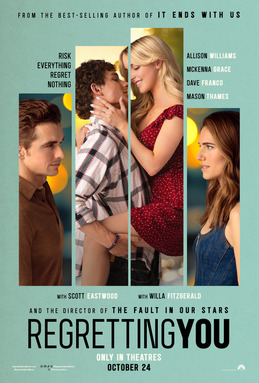
With scenes of guilt and romantic gestures, turning the novel, “Regretting You” into a charming movie, it highlights the importance of relationships and trust toward loved ones. The emotional roller coaster throughout the movie focuses on the complex relationships that the characters have experienced.
“Regretting You,” the recently published movie (PG-13), Oct. 24 2025 was based on a popular 2019 bestselling novel by author Colleen Hoover published on Dec. 10 2019. The theme of the movie is of mother-daughter relationship struggles, forgiveness and uncovering the harsh reality that they didn’t dare to face.
The movie is about the strained relationship between a mother, Morgan Grant (Allison Williams), and her teenage daughter, Clara Grant (Mckenna Grace). Their relationship becomes more complicated when a tragic car accident kills the family’s patriarch, Chris Grant (Scott Eastwood), Morgan’s husband and her sister, Jenny Davidson (Willa Fitzgerald). The movie follows grief, insanity and secrets as Morgan thinks she is protecting her daughter by hiding the truth about an affair between Chris and Aunt Jenny. However, it only makes Clara more rebellious as she ends up falling for the forbidden boy, Miller Adams (Mason Thames) because his father went to jail for selling drugs.
As both women embark on their own path to healing and self-discovery, they start to distance themselves from each other. I really enjoyed the storyline because it gave a contrast of how an unusual family deals with grief and bizarre events. The plot tells us a theme of regret, as the characters look back at their past and consider what it means to find a second chance at life and happiness.
When I went to Harkins Theater, I already read the novel “Regretting You,” so I had high expectations for the movie. The movie was similar to the novel, which I thought was a pleasant experience. My friends and I were very intrigued by the movie because we all loved the author and I highly enjoyed it.
The movie scenes had a stereotypical country vibe, where it had lots of trees and long roads that seemed never-ending. The movie matched the book quite well and I felt that the actors played their part with a lot of passion and portrayed very convincing characters. Knowing the book, I compared it to the movie and though some parts of the movie were slightly changed, the overall concept was still there.
I felt the emotional awkwardness when there were some parts where it got really conflicted between Clara and Morgan’s relationship. The scene was very genuine because as teenagers grow up, they tend to act very moody and start talking back to their parents. In the movie, there were multiple instances where Clara and Morgan were fighting about how they were keeping secrets from each other and not telling the truth. The arguing scenes felt relatable because no one is perfect and the movie reflected on the disagreements that a lot of teenagers have experienced.
“Regretting You” reflects how past choices and unaddressed issues can have an impact on individuals and their relationships, especially within a family. The movie shows that honesty is the foundation of strong relationships toward one another. The plot was applicable to real life because it gives people a deeper value into what family and relationships are all about. This movie is the comparison and real-life actions of the novel. The film was either going to be a really impactful movie, or it was going to lack a lot of details that were described in the book. Despite the pain and the conflict throughout the movie, the plot explores the strength of family bonds and the potential for love and happiness to be found again.
Taking all of this into account, “Regretting You” deserves a 4.5 out of 5 stars rating. I enjoyed watching the relationship between Clara and Morgan and how they were able to cope with the guilt and tension of the affair. I appreciated the similarity of the book and the movie because it gave me a visual of the book rather than picturing it myself. Walking into the theater as a fan of Mckenna Grace and Mason Thames, I walked out with a smile on my face.