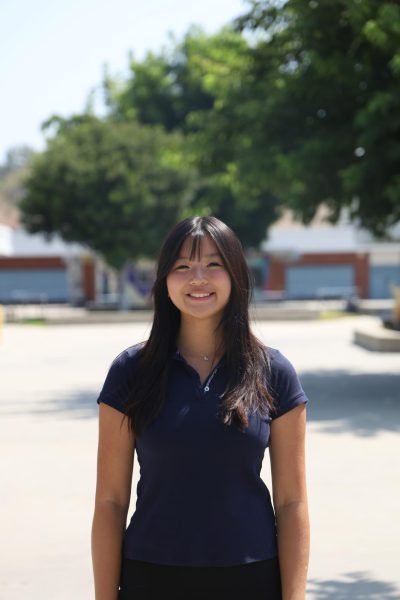
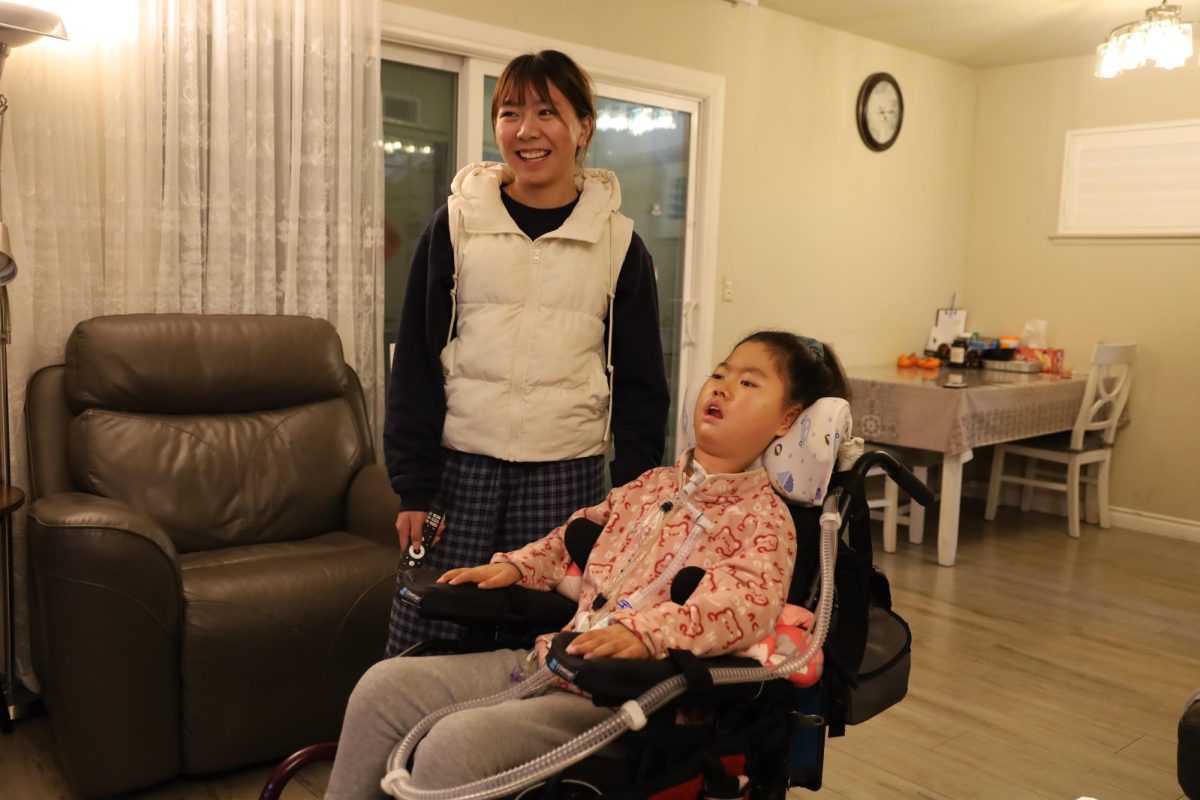
As a soft song echoes through the living room, senior Skyler Wan smiles and gently taps on her little sister Esther’s arms—following the rhythm, and trying to communicate. While other students’ after-school routines consist of finishing homework or clocking in at their part-time jobs, Wan’s routine revolves around taking care of her 9-year-old sister, who has a disability.
Wan’s sister is diagnosed with type 1 spinal muscular atrophy (SPA), a disorder that results in loss of motor neurons and progressive muscle weakness. Esther’s disability impaired her ability to talk, breathe and eat since birth. For the past four years of Wan’s life, Wan has served as one of Esther’s primary caregivers alongside their parents.
“[Esther] requires constant attention and care,” Wan said. “When I get home from school, I sit next to her and [monitor] her. Although it can be stressful, I enjoy my time with her.”
Wan and her family first found out about Esther’s condition when they were living in Chongqing, China. While type 0 SPA patients usually pass away within 10 days of birth, Esther started displaying type 1 symptoms of increased weakness a few months after birth. At the time, Wan was only 9 years old.

“My parents didn’t know what to do,” Wan said. “All the doctors said that she cannot survive past a year because that’s normally how children with SPA end up in China.”
After consultation, Wan’s parents decided to seek treatment for Esther in the United States, leaving Wan with her grandparents in China before she moved to the States herself shortly after, when she was 14 years old.
“At first, I felt abandoned,” Wan said. “For the first nine years of my life, I was an only child; all the attention was on me. After my sister was born, she needed that attention and at the time. I didn’t understand [her needs] until later.”
Since then, Wan has supported her family by taking on major responsibilities in caring for Esther, which takes one to two hours of her time per day. Because Esther needs to be hooked up to a specialized breathing machine at all times, Wan checks for phlegm in her nose or throat to suck it out with the machine. She makes sure to monitors Esther’s heart rate and spends time doing calming bonding activities with her, such as watching TV.
“Before, Esther wouldn’t be able to [communicate] which [channels] she wanted,” Wan said. “When she began yelling and crying, we found hope in that change. Every time she yells, my family and I now know, ‘Oh, this is the wrong one.’”
Inspired, Wan channeled what she learned with Esther into her love for psychology. At a psychology clinic she volunteered at under the guidance of Dr. John Pellitteri in Rancho Cucamonga, Wan performed tests as part of a curriculum that helped her gain insight into people’s adaptability to change and find ways to help her sister. Now, she designs sensory games to improve how Esther communicates—playing songs for her and performing different motions depending on the pace. Wan’s experiences motivated her to start Walnut Psychology Club on campus and apply to be a Peer Counselor during junior year.

“Having a sister who needs more care makes her a more empathetic person,” Peer Counselor senior Gerilyn Funk said. “She knows how to balance lots of things and take care of someone who isn’t herself, it puts her in a position of being a caregiver to her friends, family and students on campus that might need extra help.”
However, Wan’s sibling responsibilities aren’t always easy to juggle. Often finding it difficult to balance caring for her sister and her academic life, she cannot participate in competitions or events that require long traveling or shifts.
“Sometimes, I want to participate in those events. Knowing I am not able to attend those can be a little frustrating, but I know that God has a plan for everything so maybe I’ll be able to in college,” Wan said.
However, despite such battles, Wan loves her sister dearly. Her favorite silly memory is trying to put lip balm on Esther, which her sister usually glares at in disapproval—to which Wan laughs in return.
“A lot of people’s first words are ‘I’m sorry to hear that’ when I tell them about my sister,” Wan said. “But actually, she’s a blessing instead of a curse. She’s the reason we moved to the United States and are able to enjoy the education here. I want more people to understand how hard [people with disabilities’] lives are. They don’t want pity. They want empathy.” Ω