Every year, new students sit down with their Grade Level Coordinators to review their graduation requirements: four years of English, two years of math, two years of science, two years of physical education and finally the two years of foreign language requirement. Most people pick a language to schedule as early as possible, checking it off in their first two years.
This year, there are a total of 12 level one, 13 level two, 10 level three and seven level four language classes, a 42% decrease between the levels because students take language classes with the sole purpose of completing the requirement— understandably so since only two years are required for the Universities of California and California State Universities, or if they do not intend to major in said language. However, while being bilingual is useful when traveling abroad or working in some specialized international jobs, it comes up constantly in everyday life.
According to the California Immigrant Data Portal, in the 2024-25 school year, about one in three students enrolled in California’s K-12 schools spoke a language other than English at home, and this translates to department stores, jobs or in offices where everyday people preside.
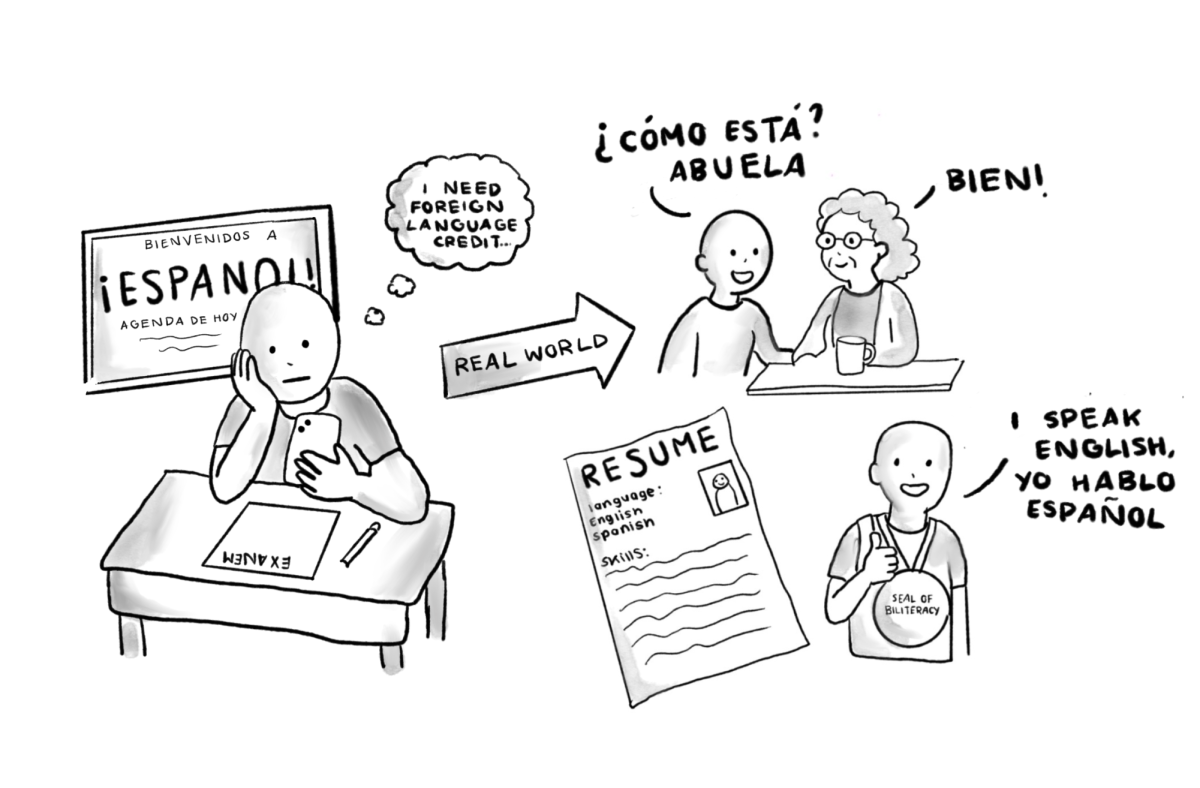
Having taken Spanish all four years of high school, there are still plenty of days where I feel I’m only understanding half of what is being taught. That’s a pretty common experience, and also part of why so many students give up early. It’s easier to write these things off as not worth your time; however, even without fully feeling confident in the language, I can still use key words to understand a conversation in Spanish, recognize the Spanish cultural influence in our community and even order my favorite asada tacos fluently. Personally, it feels like a waste of time and effort if students are dedicating two years of their high school career to a language, only to replace the class after the requirement is met.
Many multilingual people also appreciate it when someone makes the effort to speak in their original language. Almost any job that involves working with people puts you in a situation where a second language would be beneficial, and a person who can use it has an edge over someone who can’t. It also signals respect and builds trust faster, which is not only essential in fields where the quality of communication affects the quality of the result but also improves regular social interactions.
California is genuinely one of the most linguistically diverse places in the country and it has already been ahead of the country on biliteracy for a while. According to the California Immigrant Data Portal, in 2012, California became the first state to offer an official State Seal of Biliteracy, a gold seal also offered on campus, that goes directly on a student’s diploma to recognize reaching genuine proficiency in the language.
At Walnut, students only need to take and pass four years of language with a 3.0 grade point average with oral proficiency or pass the Advanced Placement or International Baccalaureate exam with a score of three or four, respectively, or higher, to obtain the seal. The opportunity is there for students, and it continues to get more attainable throughout the country. Students on campus should take advantage of it more.