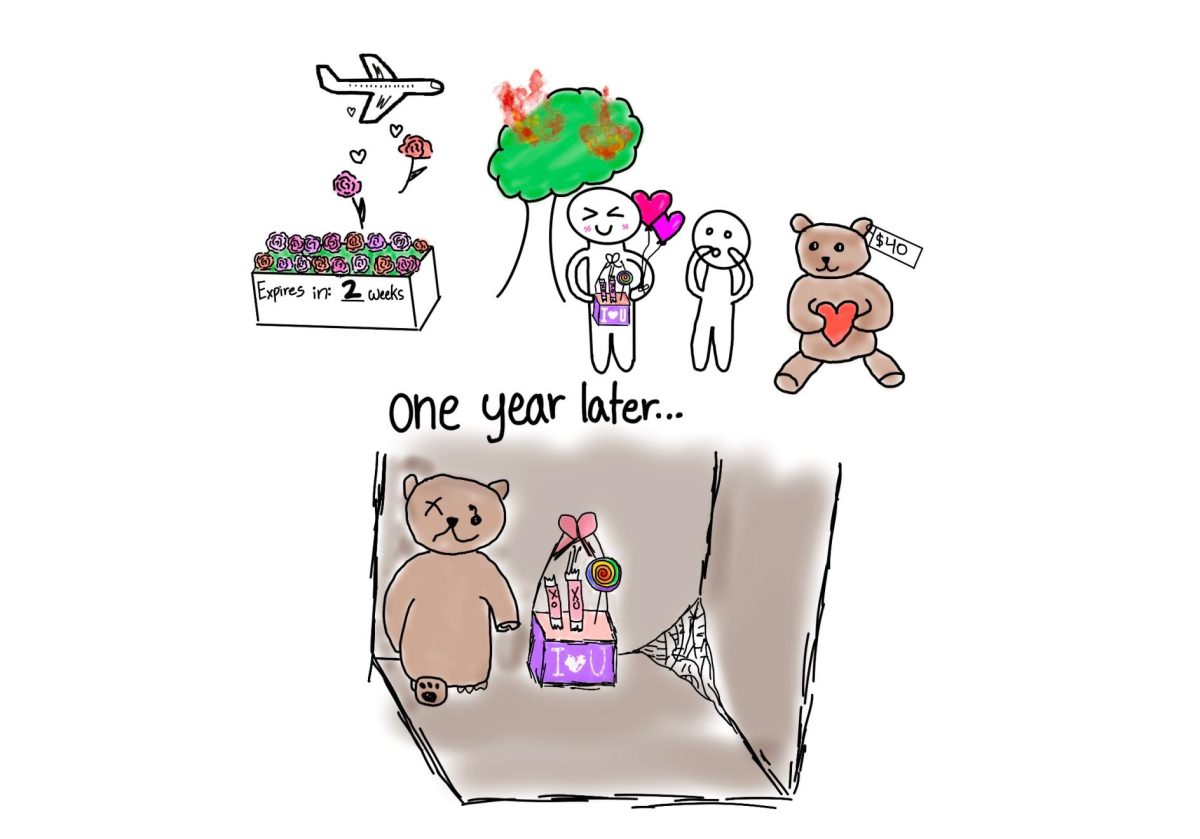
Whether it be going to a Target or Costco, you have likely seen those giant 5-pound chocolate hearts, heart-shaped mini-squishies or other small gifts advertised as a “great gift,” when in reality, they are just made out of plastic that will likely break or stop being “cute” in a few weeks. But when those things end up in the trash can, no one stops to question how many resources they just wasted to make their gift basket look aesthetic.
Every major holiday, people give gifts to their friends and family, but Valentine’s Day is a minor holiday with just as many gift-giving obligations. Personally, I think people should spend time with people they care about or do something they enjoy together rather than going out and buying something the other person might not even want.
Common gifts include giving fake flowers and stuffed animals, but how many stuffed animals can one person have? Moreover, physical gifts often look nice, but hold no real meaning to the other person, leaving the environment to suffer for years just because someone wants a few seconds of joy. The National Retail Federation (NRF) estimates that spending from American consumers in 2026 alone is expected to reach a record $29.1 billion, with the numbers constantly increasing each year.
Even when avoiding cheap plastic presents, people give bouquets or chocolates, but flowers themselves are taken at such an overconsumed rate that it too becomes an increasingly negative gift for the environment.
The NRF estimates that Americans will spend $3.1 billion on Valentine’s Day flowers this year, and the Society of American Florists states that 250 million roses were produced for the holiday. This contributes to the amount of greenhouse gases released in the mass production cycles and resources used in large amounts, especially when they are shipped from various countries. The Washington Post reports that 80 percent of these roses were imported from Colombia, Ecuador and the Netherlands, and weeks prior to Feb. 14, over 30 flights were transporting flowers from Colombia to Miami every day.
Even chocolate boxes add to environmental pollution. Sky News reports that when weighed, Ferrero Rocher boxes are 42% packaging, and even then, just 11% of that is recyclable. When the amount of plastic waste is added to the initial production resources, the question arises of whether or not those few seconds of happiness is worth the deep footprint we created in the world. When it takes about 450 gallons of water to produce a single 100-gram (3.5-ounce) chocolate bar or 1.8 to 3.4 gallons of water to produce a single commercially grown rose in that 20-rose bouquet, the question arises of whether or not that little bit of happiness is worth the resources we consumed for it.
Personal touches with cards and thoughtful messages have vanished over the years, leading us to be where we are today. Somewhere along the way, people started caring more about the materialistic side of this holiday rather than the personal meaning it is supposed to represent. Now, it’s more about grabbing whatever looks the most aesthetic off the shelves or finding whatever fits best with the gift basket you’re making, whether it’s buying a dozen “Rainbow Mystery Squishy Dumpling” sets to find the glitter one, or using just a bit of extra mylar shred to fill up that space in your plastic basket.
Instead, people can go somewhere together or give each other cards that express how they really appreciate each other. People don’t have to stop celebrating the holiday, but they can celebrate in a way that actually matters — spending time together.